

Why Your History Buff Friend Pauses Every Movie
Why history lovers prefer weight, craft, and provenance over novelty, and how to choose a gift a history buff will actually keep using.

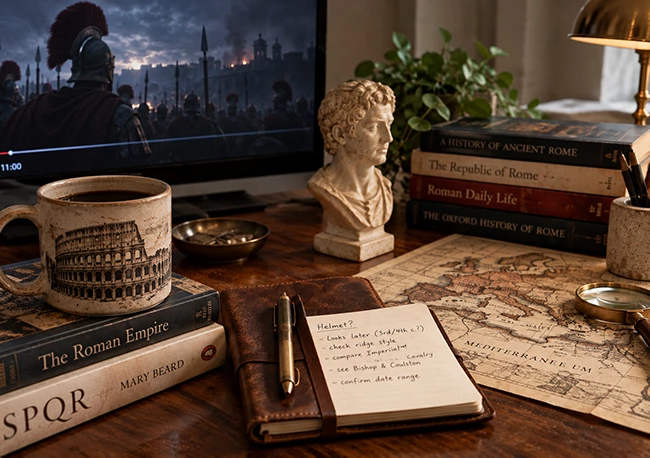
A friend of mine once paused the first episode of a Roman miniseries eleven minutes in, held up one finger, and informed me that the centurion’s helmet was about a century too late. He then spent twenty minutes on his phone confirming it, the episode frozen on a close-up of a man mid-sentence. I’d like to say I sat there above all this, but I was the one who asked which century it should have been. Neither of us was enjoying the show in the ordinary sense, and we were both having a wonderful time. Old habits die hard, especially when those habits involve fact-checking a screenwriter against a three-hundred-year-old shipping ledger.
From the outside, spending a Saturday afternoon reading about the grain supply of the Roman Republic or the winter rations of the Union Army looks like an elaborate form of escapism. A way to hide from the present. Look closer, though, and something much more practical is going on.
We live in a moment that moves too fast to leave much of a physical trace. News cycles evaporate in six hours (the cheating scandal you had strong opinions about at lunch has been replaced by a streamer controversy by dinner). Software updates rewrite the interfaces we use every morning. Most of the objects we touch are smooth slabs of aluminum and glass, designed to be replaced the second the battery degrades. Nothing has weight, and nothing shows how it was made. For the history enthusiast, turning toward the past is a deliberate counterweight to all that frictionless speed. If you’ve ever gone hunting for Gifts for History Buffs, you’ve probably noticed how quickly they pass over shiny modern gadgets in favor of things with a little grain and permanence. They want weight. They want provenance.
Psychologists who study nostalgia and material culture have long noted that people use the past as a stabilizing anchor when the present feels restless. Our fondness for eras we never lived through is rarely about wanting to give up modern dentistry or indoor plumbing. It’s a longing for legibility. When you hold a heavy-bottomed 10.5-ounce rocks glass etched with Cicero’s maxim Historia Magistra Vitae, or run your thumb across the matte paper of an architectural print of ancient Rome, you’re touching something that refuses to hurry. You can see the lineage of the idea. Material craft gives the brain a physical surface to hold onto. A 9.4-ounce brushed fleece hoodie printed with archival reference typography, or a black ceramic mug honoring England’s 1652 “penny universities,” works because it brings that lineage into an ordinary Tuesday morning. The object has a job to do, and it carries a story while doing it.
There’s also the relief of a slow burn. Modern digital life trains the brain to skim. We jump from headline to notification to thirty-second clip, grazing on information without ever digesting it. Historical mastery demands the opposite posture. You can’t skim the collapse of the Bronze Age, and you can’t speed-read your way through the political correspondence of 1861. Tracing a single cause across three centuries takes patience, a tolerance for ambiguity, and a willingness to sit with primary sources that refuse to summarize themselves. That slow accumulation of context works as an antidote to instant gratification.
It serves a pragmatic purpose, too. People who spend their evenings reading about dead civilizations are rarely hiding from the future. They’re gathering data points. Technology changes at a blistering pace, sure, but human ambition, vanity, courage, and miscalculation stay stubbornly consistent. History buffs are pattern-recognition enthusiasts with a very large sample size. When someone scribbles notes inside a 150-page spiral journal titled Same Mistakes, Different Century, the joke lands because it’s grounded in observation. Studying how people navigated crises four hundred years ago makes the modern maze feel a little less unprecedented.
This is exactly why buying a present for a history lover trips so many people up. We fall into the spotlight effect in gift-giving, convinced the recipient will judge our intelligence by how obscure or monumental our choice is. We spend hours overthinking gifts, comparing eight-hundred-page biographies they almost certainly already own, or hunting for museum replicas that have nowhere to live except the back of a closet. Sometimes we get so stuck that we resort to asking what someone wants outright, trading away the quiet pleasure of showing we paid attention. You don’t need to out-research a historian to give them something they’ll keep.
Think about how old traditions survive in everyday objects. Even small customs, like the centuries-old superstition about never gifting an empty wallet that appears in Russian, Chinese, Greek, and Filipino traditions, endure because people love attaching tangible rituals to the things they carry every day. History lovers operate on that same wavelength. Skip the decorative trinkets that only announce a theme for the five seconds it takes to tear off the wrapping paper, and look instead at the physical routines that already anchor their day. The coffee cup sitting beside their keyboard while they read primary sources. The canvas or fleece they reach for when the study gets cold, the neoprene mat under their mouse, the glass they pour into when the books come out at nine o’clock.
Choose something with real material weight, honest utility, and an insider nod to the past, and you’re giving them something modern life rarely offers. A little permanence.

Dattaraj Pai
I’m the founder of Science of Gifts, a website dedicated to helping people find meaningful and thoughtful gifts. With years of experience researching the psychology of gift-giving, I explore how gifts communicate emotions, strengthen relationships, and create lasting memories.
Beyond writing about gifts, I have a background in storytelling and filmmaking, which fuels my passion for exploring the cultural impact of meaningful gestures.