



What Makes a Good Gift for a Civil War Enthusiast?
Civil War fans rarely want the same thing. Learn how to match a gift to their real interest, from soldiers’ rations to the Emancipation Proclamation.

Some people watch a documentary about the American Civil War and come away with a broad understanding of the conflict. Others spend the next three hours looking up a particular regiment, comparing battlefield maps, and wondering whether a decision made in 1863 changed the course of the war. If you’re buying a gift for the second kind of person, you probably already know that a generic history book isn’t necessarily going to cut it.
The difficulty is that an interest in the Civil War can take many forms. One person is fascinated by military strategy. Another collects historical prints or reads soldiers’ letters. Someone else enjoys the peculiar details of nineteenth-century life, from military rations to the medical practices of the period. They all love history, but they don’t necessarily want the same things.
I know one enthusiast who keeps a piece of hardtack on his desk, officially for research. He has a standing offer of five dollars to any guest who can bite through it. Nobody has ever collected, and he treats this as a historical finding rather than a party trick. His shelves hold plenty of campaign histories, but it’s the hardtack that gets mentioned whenever his name comes up.
That’s what makes choosing a good gift interesting. The goal isn’t simply to find something with a Civil War connection. It’s to find something that reflects the particular reason the subject has held someone’s attention for so long.
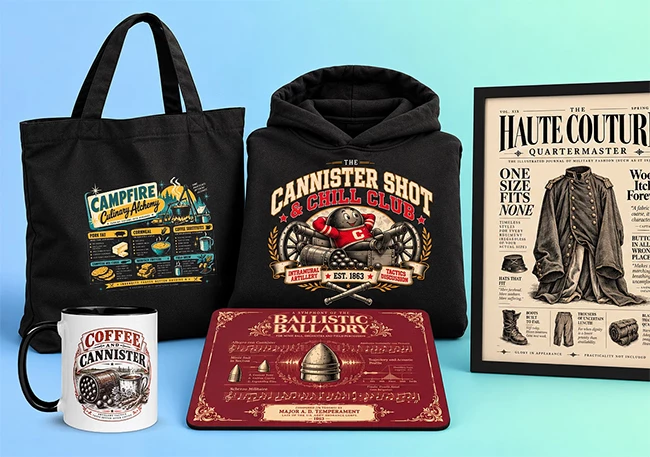
If you’re looking for inspiration, our collection of Civil War gifts features original designs inspired by the conflict, its material culture, and the strange and fascinating details of the era. Some are deliberately historical in appearance; others take a more playful approach. The trick is knowing which direction will appeal to the person receiving the gift.
Consider the enthusiast who is fascinated by the practical realities of military life. They may know the major battles and generals already, but what really interests them is how ordinary soldiers lived: what they ate, what they carried, how they treated injuries, and how they endured conditions that are difficult to imagine today.
For someone like this, a reference to military rations might be more interesting than another portrait of a famous general. The Civil War Field Rations Ceramic Mug takes an everyday object and connects it to one of those less glamorous aspects of the war. It’s the kind of reference that can be appreciated over a morning coffee, especially by someone who enjoys the details that tend to get left out of the grand narrative.
Other history enthusiasts are drawn to the documents and political decisions that shaped the conflict. They want to understand not only what happened on the battlefield but what people believed they were fighting for, how those beliefs changed, and how the consequences of the war extended far beyond its final battles.
For them, the Emancipation Proclamation is not simply a familiar title from a history textbook. It is a document whose meaning, timing, and consequences invite serious discussion. A design that takes its inspiration from that history can acknowledge the political dimension of the war without reducing it to a collection of dates and military victories.
The Emancipation Proclamation Distressed Art Print is one option for someone who appreciates historical documents and the visual character of archival material. It draws on the appearance of an old print, making the historical reference part of the design rather than an explanation pasted underneath it.
Then there are the enthusiasts who enjoy the stranger details of history. They might read about battlefield medicine, experiment with historical recipes, or follow a documentary down a rabbit hole about equipment and supplies. They are interested in the practical world behind the familiar names and dates.
These are often the people who appreciate a gift with a little humor, provided the joke comes from a genuine understanding of the subject. A cocktail glass inspired by the demands of a difficult campaign, for instance, approaches military history from an unexpected angle. The Prescriptions for a Tough Campaign Cocktail Glass combines a modern drinking glass with a reference to the hardships of military life. It is playful without needing to turn the entire subject into a punchline.
Of course, humor isn’t right for every recipient. Some people enjoy a wink at the absurdities of history; others prefer gifts that treat the subject with greater seriousness. The important distinction is whether the person enjoys that kind of playful interpretation. A joke that makes one enthusiast laugh might strike another as trivializing something they care deeply about.
There is also a difference between someone who likes learning about the Civil War and someone whose interest has become a substantial part of their life. The latter may already own a shelf full of books, have strong opinions about particular historians, and know far more about the major campaigns than you could reasonably hope to learn before their birthday.
Trying to impress such a person with how much historical information a gift contains can be a mistake. They may already know it. A more successful gift might acknowledge their interest without attempting to teach them something.
This is where the design of an everyday object can be useful. The Hindsight Is 1861 Sweatshirt takes a familiar expression and gives it a historical twist. Its appeal depends less on presenting new information than on recognising the way history enthusiasts think about decisions and their consequences. For someone who enjoys discussing the turning points of the war, that connection may be more amusing than another basic illustration of a battlefield.
Practicality matters, too, although not in the sense that every gift needs to be useful in the conventional way. A mug can become part of someone’s morning routine. A print can find a place in a study. A sweatshirt can be worn without requiring the recipient to explain their entire interest in nineteenth-century American history to everyone they meet.
The object should have a life beyond the reference. If it is something the person would never use, display, or wear, the historical connection may not be enough to make it a good choice.
It’s also worth thinking about how openly someone likes to express their interests. Some enthusiasts enjoy clothing and accessories that make their subject immediately obvious. Others prefer designs that reveal their meaning only to people who recognize the reference. Neither approach is inherently better. They simply reflect different personalities.
The same consideration applies to historical accuracy and presentation. Someone who collects original documents or studies period artifacts may be particularly attentive to details that a casual enthusiast would overlook. If you’re buying a modern design inspired by the Civil War, it should be presented as a contemporary interpretation rather than an authentic historical artifact. That distinction matters to people who care about the difference between historical evidence and modern representations of the past.
Ultimately, the most useful thing you can know about a Civil War enthusiast is not how many books they’ve read or which battle they find most fascinating. It’s what they keep returning to. Do they talk about military decisions, political history, the lives of ordinary soldiers, or the objects people carried into the field? Do they enjoy serious historical interpretation, or do they appreciate a well-placed joke about the past?
Those observations are much more revealing than the broad label of history buff.
The Civil War is a vast subject, encompassing political ideals, military campaigns, personal experiences, and the ordinary realities of life during a national crisis. Two people can spend years studying the same conflict and be drawn to entirely different parts of it.
A thoughtful gift recognizes that difference. It doesn’t need to summarize the war or demonstrate how much the giver knows. It simply needs to show that they’ve noticed what makes the recipient’s interest distinctive. That’s often what turns an object related to history into a gift that feels genuinely personal.

Dattaraj Pai
I’m the founder of Science of Gifts, a website dedicated to helping people find meaningful and thoughtful gifts. With years of experience researching the psychology of gift-giving, I explore how gifts communicate emotions, strengthen relationships, and create lasting memories.
Beyond writing about gifts, I have a background in storytelling and filmmaking, which fuels my passion for exploring the cultural impact of meaningful gestures.